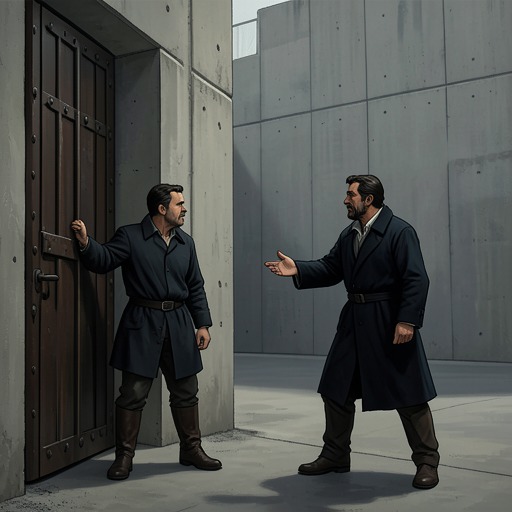
Robert Langdon and Katherine Solomon
The Lost SymbolRobert Langdon and Katherine Solomon are old friends whose trust becomes an active partnership in the effort to decipher the Masonic Pyramid and save Peter Solomon. Their bond is tested by a choice between preserving the pyramid’s secrets and using its capstone to pursue Peter’s rescue; it also becomes practical under pressure, as they share painful revelations, evade surveillance together, and seek sanctuary at Washington National Cathedral.
The Basis of Their Trust
At the United States Library of Congress, Katherine reaches Langdon after a night of fear and confusion and rushes directly into his arms. The embrace is more than a moment of relief: the narration identifies him as an old friend, and his reassurance that they will find Peter gives her something to hold on to before she can explain what has happened. She wants him to know that the man who destroyed her laboratory is also responsible for the deaths of her mother and nephew, but the alarm of an intruder interrupts her. Their reunion therefore begins with affection and reliance, then is immediately forced back into danger.
Warren Bellamy leads them through the library and hands Langdon a bag containing a small, engraved stone pyramid and its cube-shaped package. Katherine recognizes the pyramid by instinct as the object connected to the devastation of her life, although she has never seen it before. Langdon takes responsibility for carrying it after Bellamy warns him not to let it out of his sight. In this moment, their roles are complementary: Bellamy entrusts the object to Langdon, while Katherine’s recognition supplies the personal history that makes its meaning urgent. The relationship is not simply companionship; it links Langdon’s commitment to Peter with Katherine’s intimate stake in the mystery.
Shared Knowledge, Unequal Grief
During their escape through the book conveyor toward the Adams Building, Langdon and Katherine lie in darkness, unable to face one another. The confined passage gives them a setting in which speech becomes their only means of connection. Katherine asks whether the pyramid belongs to Peter, and Langdon confirms it. She then explains that, ten years earlier, an intruder broke into the Solomon estate demanding a pyramid. Her nephew, Zachary Solomon, had told the intruder about it before being killed in prison; the same attacker then killed Katherine’s mother, Isabel Solomon. Katherine had believed the man died during that earlier attack, until he resurfaced as a supposed psychiatrist and gained her trust by knowing private details about her family and work.
Katherine’s account changes Langdon’s understanding of the night: the attack on her laboratory and the old murders are parts of the same pursuit of the pyramid. Langdon, in turn, tells her what he has withheld: Peter entrusted him with a sealed package years earlier, he was lured to Washington with it, and Peter’s severed hand was found in the Capitol Rotunda. He also explains that Peter’s captor has promised to return him alive if Langdon can decipher the pyramid. The two friends exchange knowledge that neither possessed in full; the revelation binds Katherine’s family history to Langdon’s earlier promise to Peter and makes their cooperation necessary to act on either.
The Capstone Dispute
In the Adams Building circulation room, Katherine examines the pyramid’s Masonic cipher and the cube-shaped package. Langdon explains that the wax seal bears the impression of Peter’s Masonic ring and that Peter had described the package as a means of creating order out of chaos. Bellamy has repeated the warning that the pyramid’s secret must remain intact, even at the cost of Peter’s life. Langdon is caught between that instruction and Katherine’s demand for action, and he tells her that he cannot easily dismiss Bellamy’s insistence.
Katherine answers from the accumulated losses behind her decision. The pyramid, she says, has already cost her Zachary and Isabel, and now Peter is in danger. Although she is a scientist and doubts that the legendary treasure exists, she is willing to test the possibility rather than let her brother die to protect an unopened secret. Langdon objects when she slips a finger beneath the old twine, but she pulls it anyway, breaking the brittle wax seal. This is a consequential difference between them, not a breakdown of trust: Langdon remains mindful of Peter and Bellamy’s warning, while Katherine treats the immediate rescue as the overriding obligation. Their partnership can withstand the disagreement because both choices arise from loyalty to Peter, even as Katherine’s grief makes inaction unacceptable to her.
Cooperation on the Run
Later, while they are riding in a taxi, Katherine notices that the intercom is on and that the driver’s phone is positioned to transmit their conversation. She alerts Langdon without making their discovery obvious. He quickly understands the danger and supports her improvised performance, which gives them an opportunity to leave the taxi at Freedom Plaza. Their escape depends on joint invention: Katherine draws attention to the Great Seal of the United States on a dollar bill, while Langdon realizes that Freedom Plaza provides access to Metro Center and several different rail lines. He adds a misleading trail toward the George Washington Masonic Memorial, and they board a train in the opposite direction.
After traveling north to Tenleytown, they emerge away from the immediate pursuit and walk across the lawn toward Washington National Cathedral. Langdon admires Katherine’s acting and she credits his improvisation in return. The exchange marks a change in the texture of their alliance: earlier, Langdon was the reassuring friend carrying Peter’s burden; now each recognizes the other’s tactical skill. They coordinate without lengthy explanation, divide the work of deception, and continue toward a place they hope will offer both safety and answers. At the cathedral doors, Langdon identifies them to the blind priest as people seeking sanctuary, presenting their arrival as a shared appeal.
The Relationship’s Narrative Function
Their friendship connects separate strands of the crisis. Langdon has been entrusted with Peter’s sealed package; Katherine knows why the pyramid reaches back into her family’s past. Neither can make full sense of the danger alone. Their conversations transform an object Langdon has carried as a puzzle into a cause of Katherine’s bereavement, while her disclosures give him the context needed to understand the attacker’s persistence. The relationship also places loyalty under pressure: Bellamy’s demand for secrecy conflicts with Katherine’s insistence that secrecy cannot outweigh Peter’s life.
The narrative repeatedly tests their trust through concrete acts rather than declarations. Katherine turns to Langdon for comfort at the library, tells him the story she had not known how to share, and risks opening the package despite his protest. Langdon tells her about Peter’s hand and the bargain with the captor, steadies her with the promise that Peter is alive, and follows her lead when she detects surveillance. Their alliance is therefore both emotional and operational: it offers comfort without removing grief, and practical cooperation without erasing disagreement. By the time they reach the cathedral together, each has helped the other move from shock toward action.